Showing posts with label education. Show all posts

Social science and global politics of knowledge

Some recent books about postcolonial and anti-colonial social science, and my chapters in them: 


Connell, Raewyn. 2025. Perspectivas democráticas na educação em Ciências Sociais. Pp. 41-53 in Marcelo Cigales, ed., Ensino de Ciências Sociais em perspectiva internacional. Maceió, Editora Café com Sociologia, 2025. 


 Connell, Raewyn. 2025. The good university. Pp.107-121 in Sinfree Makoni and Chanel van der Merwe, ed., Decolonial Options in Higher Education: Cracks and Fissures. Bristol and Jackson TN, Multilingual Matters. 


Connell, Raewyn. 2025. Curriculum for revolution: Ali Shariati's Practical Plan and the radical politics of knowledge. Pp. 93-109 in Dustin J. Bird and Seyed Javad Miri, ed., Ali Shariati: Critical Social Theory and the Struggle for Decolonization. Kalamazoo MI, Ekpyrosis Press.

Gender, truth, populist politics


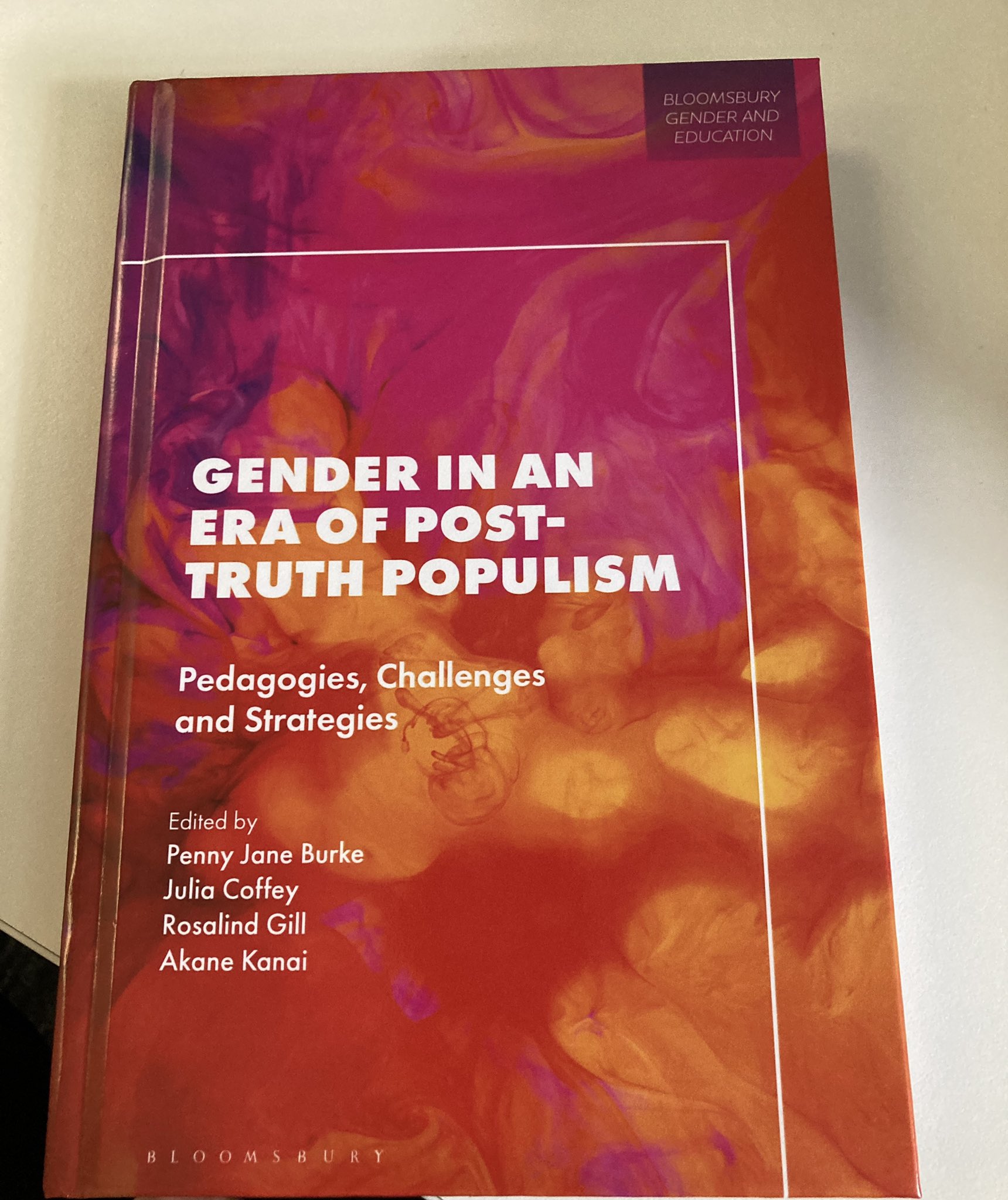
A new book about feminism, education, and the challenges to truth from new right-wing politics has been published, with general analyses, case studies, and discussions of how to respond.

I have a chapter in it. Here's the reference: Connell, Raewyn. 2022. Truth, power, pedagogy: Feminist knowledge and education in a 'post-truth' time. Pp. 65-77 in Penny Jane Burke, Julia Coffey, Rosalind Gill and Akane Kanai, ed., Gender in an Era of Post-truth Populism: Pedagogies, Challenges and Strategies. London: Bloomsbury Academic.

Teachers' Worth


In this essay I discuss the nature of teaching and the circumstances of teachers' work and lives. It was written as a submission to the 2020 Inquiry Valuing the Teaching Profession, sponsored by the NSW Teachers' Federation. The essay builds on recent debates and writing about teachers, on my experience as a researcher concerned with school education, and on what I have learned as a teacher in the tertiary sector.


Teachers' Worth

Teachers' cultural position

In graduation ceremonies for Education degrees, the invited speaker often includes a fanfare for the teaching profession, telling the graduands they are bearers of cultural traditions, mentors of the rising generation and gatekeepers to the future. These ideas sound like clichés, but they are not just boilerplate. Teachers do have a central role in the culture.

Ever since mass school systems became a reality, teachers have been the main agents for the growth of literacy, the formation of skilled and professional workforces, the broad dissemination of sciences and humanities, and a large part of young people's social learning. Teachers' work underpins our society's achievements in public health, economic and technological development, literature, music and art. In a society with many regional, ethnic and religious differences, teachers' work in schools is essential for social connection and cohesion. The role is so broad and so important that when social troubles emerge, politicians and journalists often blame teachers for causing the problems, or require teachers to fix them.

In social-science discussions, teaching is sometimes defined as the archetypal 'new profession'. School teachers are trained knowledge workers, now usually with university degrees. They are unionized, wage-earning rather than fee-earning, employees rather than self-employed, mainly working in the public sector, with high proportions of women and entrants from working-class backgrounds. All these points have to be qualified in detail, but they are broadly correct. Teachers as a group not only perform important tasks for society but have themselves been significant players in economic and social change.

Teaching is in one sense the best-known profession of all. In a society where almost every child goes to school, almost every adult has had a close-up view of teachers doing their daily work - or at least, part of it. Many adults hold great affection for particular teachers who were important in their lives. But other memories may be negative, even angry. Many people also imagine, from a limited knowledge, that teaching is an easy job with short hours and long holidays, something that anyone could do, only needing quick-and-dirty training. The public image of teachers is genuinely complicated.


Teaching as work

If you enter ‘teachers’ and ‘work’ together into the widely-used bibliographical database Google Scholar you will find over four million references in the English language alone. There are two hundred and eighty thousand references if you use the phrase ‘teachers' work’ as an exact search term. I would judge that at most a thousand items, perhaps less, form the core research-based literature. The larger figures illustrate how widely discussed teachers and their work are, and how frequently questions about teachers connect with other educational issues, from curriculum to public policy, assessment, and pedagogical method.

The sociology of work speaks of the 'labour process', which means not only which tasks the worker performs, but also, crucially, how these tasks are organized. Three features of the teaching labour process are crucial. Teaching is interpersonal, composite, and unbounded. Forgive the jargon, I'll explain.

            (a) Teaching always involves connections between people: it consists of human encounters. These may be intense or formal, short or sustained, one-to-one or one-to-many, even some-to-many (in team-teaching). Whatever their form, the element of encounter is always there. Encounter is interactive.  Pure top-down instruction is part, but only a minimal part, of actual teaching.

To play an effective role in someone else's learning, the teacher must learn what the pupil's current capacities and motivations are, and what the pupil needs to take the next step in learning. Then again, for the step after that; and so on. The teacher's capacity to learn about the pupils is a crucial element in teaching, perhaps the most important element of all in effective teaching. The more diverse the cohort of pupils, the greater the professional demand upon the teacher in sustaining the pupils' learning.

            (b) Teaching is a composite labour process. Close-focus ethnographic research in schools has made this clear. Any teacher giving a detailed account of a working day could demonstrate it too! In day-to-day classroom time, teachers do multiple forms of work, often switching very fast between them and sometimes doing several tasks at once.

Classroom work includes the complex intellectual labour of understanding the pupils and transforming the curriculum into classroom practice; this is the most easily recognized part of the job. But the job also requires (as more recent studies emphasise) emotional labour: creating connection with class members through shared interest, encouragement, humour and sometimes anger; keeping focus in the classroom by managing pupils' boredom, excitement or distraction; dealing with conflict in the class and the effects of tension and trauma in the pupils' lives. As well as the intellectual and emotional labour, the teacher also has significant classroom administration: keeping records, managing equipment, providing materials, administering tests. It seems that the administrative labour has increased in the last few decades, with growing official requirements for testing and other forms of documentation. On top of all this are tasks outside the classroom. These are also varied, requiring a range of skills: preparation of classes, supervision in break times, organizing sports, arts and hobby groups, arranging and supervising events, speaking with parents, reading official circulars, participating in staff meetings, attending in-service programmes, and so on.

            (c) Partly because of the interactive and composite nature of the labour process, teaching is difficult to keep within bounds. Some of the job goes home in the briefcase at the end of the day: reports to write, assignments to mark, lessons to prepare. Some of the job goes home in one's head: the knots and tangles of classroom life, the pupils who are slipping behind for no apparent reason, the thrills and successes in the teaching process.

All this is hard to limit, since teachers know that what they do affects their pupils' lives, just as the Graduation Day speech said. The legendary ‘first year out’ (which may take more than one year) is a baptism of fire for many young teachers because of the workload and the emotional demands. Later on, even highly engaged and successful teachers may find they burn out. There is a cumulative effect of the complexity and pressure. To survive in the long run, teachers have to find a balance between over-commitment and self-protection. Support from colleagues is important in finding this balance.


Workforce and situation

Though mass media images of teachers emphasise colourful individuals, good or bad (the movie Dead Poets Society has both), no teacher really works alone. As with many other forms of labour, in teaching most effects are produced by the workforce as a whole. Any teacher in her classroom is building on the work of all the teachers who have worked with those pupils before. What happens in the classroom is shaped by what happens in the next-door classroom and by the routines of the whole school, the discussion and planning that happens in staff meetings, the engagement of school principals and senior teachers, the daily work of office and maintenance staff, the constant informal discussions and exchange of information that happens in staffrooms and around the school office. Researchers recognize this when they speak of schools as organizations and try to characterise school culture, climate or atmosphere.

Beyond each particular school is all the work of other schools, as well as system administrators, curriculum developers, specialist support staff, assessment authorities, teacher organizations, and teacher educators. The work of all these groups frames what happens in any individual classroom. Education on a mass scale, in a large public school system, can only happen because the work is done by this whole workforce - the ‘collective worker’ in the jargon of industrial sociology. Each person's labour is dependent on, and supported by, the labour of many others.

It is not surprising that attempts to measure teacher effectiveness on an individual basis run into trouble. The German sociologist Claus Offe showed half a century ago the fundamental flaw in attempts to measure individual or even occupational-group productivity as a basis for wage determination in large-scale modern organizations, and this applies to education systems.

Across a large school system, teachers must deal with varied groups of pupils. One school is located in a quiet, mostly White suburb with a high proportion of professionals and managers, while another is in a crowded, multi-ethnic city area with a high proportion of recent migrants. Another is in a depressed rural area with high youth unemployment and very few resident professionals; and so on. Some of the students will be academically engaged, others in conflict with the school. In any age group there will be students with disabilities, behaviour problems and complex wellbeing needs.

I won't dwell on what everyone knows about inequality in Australia, but I do think it is important to recognize that social inequalities are educational issues. Poverty and wealth, remoteness, urban conditions, ethnic and religious difference, indigenous or settler background, physical difference and disability - all these confront teachers with different conditions and combinations of tasks in different schools. Private schools are able to choose how much diversity they care to accommodate. But it is the nature of a public education system that all groups of students must be included and supported. The demands on teachers' professionalism and learning capacities are greater.

We have long known that in education, formal equality of provision does not mean equality of outcomes. In Australia we have an unfortunate history of segregated public and private school systems.  The cynical political strategy of diverting public funds to support private schooling for the more privileged makes our educational problems worse. One of the damaging things it does is to divide the teaching workforce, creating separate career paths which limit rather than enrich professional experience.


New pressures

Teachers and their work have long been subject to controls of various kinds: religious, political, managerial and professional. Not far back in history, teachers were expected to show rigid conservatism in dress, manners and attitudes, in private life as well as working hours. Some of this has changed, as teachers asserted their citizen rights. But teachers can still be targeted in moral panics, as the right-wing campaign against the Safe Schools programme in Australia showed. Contemporary concerns about sexual abuse of children have required teachers to observe more restrictive rules about physical contact with pupils in everyday school life.

In the last few decades new means of regulation of teachers' work have developed, generally involving control at a distance. This is euphemistically called ‘accountability’. On-line templates and information systems, heavier and more detailed reporting requirements, standardized testing on a huge scale, quantitative targets and incentives, are now familiar in the education sector. Individual schools and teachers are supposed to have easily-measured goals and are made individually responsible for achieving them, as if schools were Dickensian firms counting up their cash. School league tables are now familiar, such as those constructed from the appalling MySchool website (‘supports national transparency and accountability’ according to its front page, giving the game away). This system constantly confronts teachers with tension between government demands for competitive standardized testing, and the need of the students for assessment tailored to their actual learning situations and patterns of growth.

Education systems have been subjected to requirements imported from other industries, with little attention to their educational effects. Competition, privatisation, accountability, managerial prerogative and market choice are now the common sense of corporate managers and form the dominant language of public policy, in Australia as overseas. They have been powerfully reinforced by the globalization agenda of the World Bank and the rich countries' economic think tank the OECD (which now administers the PISA global testing system for schools - how did Education Ministers let that happen?).

There is growing evidence about the impact of new technology on teachers' work. These changes are often hyped as modernization flowing from technological innovation. this is of course the view of the tech companies. Computers and the internet do offer many possibilities for enrichment of teaching and learning of new skills. Whether these possibilities are realized is another matter. ICT in education must also be seen in the context of changing management practices and the rise of corporations that sell textbooks, curriculum materials, tests, journals and management templates. There is formidable pressure here to standardize teaching practices, discourage the messiness of experimentation and local engagement, and re-shape teaching as a measurable technical performance rather than a complex human encounter. A few decades ago, we laughed at the insulting idea of a 'teacher-proof curriculum'. We should laugh no more, as current ICT and corporate strategies make it more feasible to reduce the skills of teachers, while still maintaining a facade of performance.


Careers and lives

In education, situations and responses change over time, sometimes quite dramatically. This is brought out in histories of school systems, biographies of educators, and research on teaching careers. Research about careers often suggests that teachers move through definite stages. They are supposed to pass from initial career choice, through initial training, to the first year out, adjusting to the real world of teaching, developing technique and acquiring experience, specializing, gaining advancement and promotion, and eventual retirement. These things do happen, of course! But the closer the focus, the more complex the changes appear, and the less fixed the stages. It would be unrealistic to tie teacher's salaries and conditions to a rigid model of stages in career development. We should be glad that there can be changes of direction, false starts, experiments and unorthodox pathways in the teaching workforce.

One reason for the complexity of careers is teachers' lives outside school. Work/life balance can be very problematic for beginning teachers, given the pressures of the first year out. Forming families and households may come at the same time as starting professional life. In Australian society work/life balance is constructed mainly as a dilemma for women, given the long-standing gender inequalities in the load of housework and child- and elder-care (little changed even in the COVID-19 lockdowns). We should be alert to the way apparently 'family-friendly' policies may actually reinforce these inequalities.

Teaching as an occupation does not escape gender divisions. Women predominate in early childhood and primary teaching, secondary teaching is more balanced, men predominate at the upper levels of university teaching and in senior management. In sectors where teaching is organized by subject areas, men predominate in physical sciences and engineering-related fields, women in humanities, social sciences and performing arts. These gender divisions become an equity issue within the profession if the teaching of younger children is seen as less skilled work than the teaching of older students - for which I can see no warrant at all - or if government concerns to boost STEM studies turn into wage/promotion incentives.

Fifty years ago we could have said that entry to the teaching profession in Australia was overwhelmingly from White Anglophone backgrounds, but also that it provided upward mobility for a significant group of working-class entrants. More students from both Aboriginal communities and non-Anglophone migrant communities have now come through teacher education and into the profession, the public sector probably changing faster than the private sector. But with the end of teaching scholarships and the rise of university fees and student debt, the sources of recruitment may become more restricted in social-class terms. If we value communication and sharing of experience across a diverse population, then having a socially representative teaching workforce seems an important goal.


In conclusion

Teachers as a group, rather than individually, have a formative role in social and economic processes. The central purpose of their labour is to help the rising generation develop their intellectual, social, practical and creative capacities, a task that is simultaneously vital, elusive and fantastically complex. Teachers have to deploy a wide range of their own capacities - intellectual and emotional, manual, creative and practical - to do the job. Though pupils encounter teachers as individuals, the work is in fact strongly collective and powerfully shaped by the institutional system. It is no wonder that teachers' public image is contradictory and that governments often reach for showy short-term solutions to tough long-term educational problems.

Teachers today have to deal with changing technologies as well as shifting policies and management practices. In their daily work they face the consequences of declining support for human services, as they deal with diverse and changing school populations, the effects of migration, economic inequality and social trauma, and the needs in pupils' lives produced by colonization, racism, family violence, disabilities and community conflicts. It is an impressive sign of teacher professionalism that so much good teaching actually happens in our public schools.
Reflections on COVID-19 and Education

Changed situations for learning

The epidemic, and the lockdown responses to it, have shifted the ground for great numbers of students. School closures meant a vast number of families suddenly had to do home-schooling and distance education. University closures have driven students online, even more than they were before. With social distancing, peer groups have been disbanded and many of the opportunities for informal learning have gone.

But there’s also more intimate disturbance. Kids have reason to fear. There’s a very dangerous virus loose in the world; old people have the highest death rates, but some young people die too. Grandparents may have gone into self-isolation; hugs may have stopped. In lockdown there seems to be more domestic violence, more strained relationships.

Some troubling issues of justice arise. Online learning needs equipment and technical skills, but not everyone has computers, good Internet access or technical skills. The ‘digital divides’ between rich and poor, white and black, urban and rural, suddenly have more importance. With schools and libraries closed, the inequality of resources becomes more important. Many students do not have a home rich in books, study spaces, or educational know-how.

Some old educational questions are raised again, forcefully. Who has a right to education? What counts as a classroom? What is a teacher’s role? – indeed, who is a teacher in these circumstances? And what makes a relevant curriculum?

The world around us

Response to the epidemic has mostly been managed by governments. Indeed, there is a startling surge in intervention and control by governments that have previously tried to shrink the public sector and leave everything to the market. Not much space has been found for community-based responses. (Despite the lessons of previous epidemics, including HIV/AIDS and Ebola, that community responses can be very effective.)

But in much of the world, including many of the large and powerful states, governments have been in the hands of right-wing populist regimes who have little respect for education or organized knowledge. And some of them are actively hostile. Powerful regimes are appeasing climate science deniers, peddlers of nationalist myths, and racists. Their approach to government draws on the business model of managerial prerogative and the military model of top-down command, far more than consensus-building and democracy.

We can say somethings stronger. The response to the COVID-19 epidemic by many holders of state power has been a shocking display of incompetence, ignorance, malevolence and self-interest. Hundreds of thousands of people have already died as a result, and more are dying all the time. We are living through a real social catastrophe. This is an incredibly difficult time for educators. But if we are to ‘recover’ into a humane and cooperative world, rather than a fearful, authoritarian and selfish world, the work of educators will be crucial.

Teachers

Teachers’ work has changed even without major change in curricula. Where teaching has moved suddenly online, a whole raft of skills and practices have to be learnt, new preparation done, new forms of assessment developed. New administrative demands are an important part of the load. Workloads leapt up in the early stages and it’s unlikely they have settled yet. As schools re-open a lot of work has to be done to get things running again, and where some pupils don’t promptly return, both in-person and distance education have to be maintained.

Teaching via Zoom or another online platform is massively different from teaching in person, even if the formal content is similar. The physical and emotional atmosphere of school or university life is gone; there is less back-and-forth, no running about, no uproar. Teaching has always involved juggling many different tasks together, switching quickly from one to another; this is much slower online. There is more room for recording and surveillance, which probably means less imagination and risk-taking.

In the epidemic, relations among teachers may also be re-shaped. The whole workforce of a school or university is involved in producing educational effects. Much of the co-ordination is quick and informal; with online work this becomes slower and more formal. With re-opening, new balances and connections have to be created. All this has to be done under emotional pressure. Teaching is inherently an emotional process, and teachers like everyone else are affected by the tensions and losses of the epidemic.

Curriculum

In this troubled situation we need to re-think what is being taught and learnt. If governments make an educational response, it is likely to prioritise vocational education and STEM, on the claim that will help with economic recovery. That’s precisely the theme of the Australian government’s June 2020 ‘reform package’ for universities, helpfully entitled Job-Ready Graduates in case anyone misses the message. But that’s a very dubious response.

The epidemic itself should now be a curriculum theme, at all levels. That includes responding to the fears and problems surrounding COVID-19. It doesn’t mean we all have to master technical details of virology, though a basic knowledge of what viruses are, how they work, and what their ecology is, certainly should be part of general education. (I think we make far too much of subject divisions between STEM and humanities or social sciences.) The curriculum needs to be relevant to the social, emotional and health problems thrown up by the epidemic. Art practices, physical education and manual skills all figure here.

The epidemic strongly reinforces the need for moral education. This doesn’t mean religious or secular dogma. It does mean teachers and pupils engaging with the issues of ethics and solidarity that COVID-19 throws fiercely at us. Where hospitals have to triage, who should be treated and who left to die? When governments offer subsidies, who should get them? If walls are built, who is inside them and who outside? In short, to quote an ancient text, am I my brother’s keeper?

(These notes were written for a blog series on the educational impact of the epidemic. The post is at https://blogs.ucl.ac.uk/ceid/2020/07/06/connell/.)


Coming Soon, To a Bookshop Near You: "The Good University"


Knowledge matters, for a democratic and sustainable world. Universities are at the centre of the global economy of knowledge. And universities are in trouble.
That’s not the official view. To managers and media, the higher education sector is booming. There are more than 200 million students worldwide, many of them ‘first in family’. Unprecedented amounts of money are flowing, and university presidents, rectors and vice-chancellors earn enormous salaries.
Yet universities are now unhappy places to work – for an increasingly precarious workforce, under heavy-handed managerial control. Corporate capital has moved in on the sector, siphoning off profits from research, tuition and loans. There are enormous worldwide inequalities in university research, and growing economic inequalities within universities. Many market-oriented governments have practically abandoned the idea of public universities, redefining higher education as an industry of vocational colleges operating as competing firms.
How has this come about? What can be done about it? What alternatives have there been? How can we democratise universities?
Like many other university staff and students, I have been wrestling with these questions for a long time. To answer them we need to think carefully about the work that universities do, the character of their workforce, the social effects that universities produce, and the worldwide picture of knowledge. We need to understand what has happened in the recent market turn and managerial takeover. And we need to learn from the many attempts, over the last two centuries, to invent new and more democratic models for universities. Only then can we offer a transformative agenda for universities.
The Good University is my report on these issues, ending with proposals for a new vision for universities, and thoughts on the politics of change. I don’t offer a blueprint, though I do sketch some possible designs. I’m basically offering starting-points for readers to work from, in the circumstances they face themselves. Democratic change will demand collective struggle and inventiveness.
The book will be published in the next couple of months: internationally by Zed Books https://www.zedbooks.net/shop/book/the-good-university/forthcoming/ and in Australia and Aotearoa/New Zealand by Monash University Publishing http://www.publishing.monash.edu/forthcoming.html.

Here is the chapter list:
Introduction
1. Making the knowledge: research
2. Learning and teaching
3. The collective intellectual: university workers
4. The global economy of knowledge
5. Privilege machines
6. The university business
7. Universities of hope
8. The good university

Survive & thrive 3: How to give a conference paper


When I went to my first discipline-based conference, as a grad student, it was not to give a paper.  The event consisted of lectures by tenured senior academics.  Most of the crowd had come simply to listen. But that was changing, and the democratic virus has been spreading ever since.
Now it is common for graduate students, and compulsory for junior academics, to offer conference papers. It's the obvious way to learn this genre; and as those ghastly career workshops explain, it is an easy way to build your c.v.  (‘C.v.’ now means a resumé of your career. The Latin phrase curriculum vitae means the course of your life. Let’s hope we can still detect the difference.)
There are traps in this business.  Here are three bad ways to give a paper: 1. Writing a journal article and trying to read it out in a conference. In a 10 or 15 minute slot you cannot read a journal article aloud. 2. Trying to show off. Often signalled by an over-clever title: ‘Queer(y)ing Hamlet: The Anti-Hero in/beyond the Anthropocene’. (I blush to admit that I called one of my early papers ‘Symbolic logic as an axiomatic-analogue model in the analysis of children's thinking about politics and large-scale social organization’. In six words: ‘Formal models for children’s social thought’.). 3. Speaking to a clique. Some papers are little more than academic faction-fighting in camouflage. You can detect them by the in-house jargon, snide put-downs, and good-guys-vs-bad-guys melodrama.
The well prepared speaker arrives at the session
Avoiding these traps, how can we do the job well? Here is my never-fail recipe, distilled from a thousand cups of evil conference coffee with a few toads and bats stirred in:
            1. Be Well Prepared. This is about 80% of the task. It doesn’t mean you have to agonize over every word, or solve the Problem of the Universe. It does mean you should think, not only about the content of your report, but also about the way you will report.
The key issue is to think about your audience. You are trying to get in direct touch with them, and the formality of the conference format creates distance (see picture below). Remember that the session is actually more about the audience than about you. The size of the crowd doesn’t matter. I have given a paper to an audience totalling seven, including the three other presenters and the chairperson, and we had a good discussion. Respect what the audience know already. (In Sociology conferences, please don’t recite that sentence from The 18th Brumaire, everyone has read it long ago!) Consider what will be new and relevant to them, and focus on that.

2. Think about the genre. This is oral communication. When I am giving a conference paper I speak from a maximum of one page of brief bold notes. They are essentially the headlines. By having no more than this, I can talk with the people in the room and not past them.
If you need to write out a full text, that’s OK: but write it as speech. If you don’t know how to do that, look at a play by Bernard Shaw or Bertolt Brecht, who wrote about ideas as drama.
It’s fine to spice your talk with a few images and a bit of text – once I used overhead projector slides, now I use PowerPoint. But do this very simply, very briefly, so the technology doesn’t mask your message. For Heaven’s sake, don’t turn around and read lumps of text off a PowerPoint slide on the big screen. Apart from the alarming crick in your neck, this completely breaks your connection with the people in the room.
The formality of the format creates distance
            3. Plan sequence & time. You are likely to have 10 minutes in an ordinary conference session. Don’t run over the allocated time: that is unfair to other participants, and people will not respect you for it.
So use your golden minutes well! Cast your survey-of-the-literature into the Everlasting Bonfire, there is no time for that. Go straight to the nub of the problem. A good rule is to state your most important idea within the first four minutes. Don’t leave this to the end, because it is easy to mis-judge the time while speaking, and you may not reach it. Which would be a pity, after coming all this way...
The order of material in a conference paper is different from a journal article or a dissertation – it’s a different situation. Here is a template that will often work (you can check the timing by rehearsing with a friend):
(a) Problem, 2 minutes: Explain very crisply the question you are wrestling with.
(b) Main finding, 1 minute 30 seconds. In a conference presentation, this can legitimately come before method and data.
(c) Reasoning, 30 seconds + 4 minutes 30 seconds. Say ‘How did I come to this conclusion?’ By doing such-and-such (Method, very very very short); and here is what I found (Materials, in a bit more detail).  Give a slice of your raw material, which really helps the audience to understand. It will be a thin slice, but that’s OK, in a conference you are really offering a sample of your work.
(d) Relevance, 2 minutes. Tell the significance of what you have done. If it does suggest something about the literature, say so here at the end: ‘Finally, as you will realize, this finding overthrows both Keynes’ model of effective demand and Einstein’s general theory of relativity’. Whoops, we are 30 seconds over the time limit, will have to trim something.

            4. When you have the floor, use it with confidence. You are, after all, the person in the room (perhaps in the world!) who knows most about this problem. You have some news worth telling. And you have an intelligent audience, proved by the fact that they have shown up at your session. Invite them into the discussion, and you will have done well.
The story goes that an Anglican bishop was asked by a young minister ‘How should I preach?’, to which the bishop replied: ‘Preach about God and preach about 20 minutes.’ In the conference you have just 10 minutes to preach, so belt it out!
In doing that, be of good heart, and show your feelings. This is a communication between people, not between robots. Tears and laughs are allowed in academic conferences. You may not be Charlie Chaplin, but every human touch will help.

Survive & Thrive at an Academic Conference, Outburst 2: How to Be an Audience


The main thing you will do at a conference is listen to other people talking.  Since this is the main thing everyone attending the conference will do,* it is worth thinking how to do it well.
In the sprawling assemblage of a large conference, there is a huge volume of information, a smaller amount of interesting analysis, and a very small handful of bright new ideas.  Your job as audience is to get a useful sample of the information, analysis and ideas; and to give the presenters some feedback.
How to choose sessions? Large conferences offer ‘streams’. These are like mini-conferences for particular sub-fields, and some people stick with a single stream for several days. This can work: I have known gripping arguments that flowed over several sessions in a stream. But it often doesn’t work. The stream may be little more than an administrative convenience - rooms and time-slots are allocated this way. You can only find out by trying.
A warning: don’t follow fame. A celebrity academic won’t necessarily give a celebrity paper. If you want a selfie with her, him or them, that’s good fun and most will oblige. But in choosing where to spend your valuable time, look for what’s intellectually interesting, above all.
Ideal conference, imagined by Raphael. Socrates upper left centre
That can be difficult, because – it’s the big paradox of these events - the official conference format actually discourages intellectual engagement.  Hundreds of 10-to-15-minute presentations in random order, punctuated by dignified speeches through a microphone on a distant stage: this is a long, long way from Socratic debate!
(Re Socrates: if you haven’t read it, rush to your friendly local library and borrow a translation of Plato’s Symposium. It is funny, a bit weird, and in the middle has a fabulous theory about sex.)
Most of the intellectual work of a conference happens after the formal sessions, or before them, or instead of them. In the coffee shops, in the corridor, in the sitting-and-waiting areas, at lunch, at dinner, over breakfast, in the park outside, very occasionally in a bedroom, more often in a committee room. I once went to a big international conference which had not got the message. There were no informal meeting spaces and there seemed to be just one small café on-site for thousands of delegates. The conference dispersed to get caffeinated.
The formal programme still matters. It provides most of the useful information; and it provides hundreds of launch-points for informal discussions. So choose a bunch of sessions and go to them.
Choose, mostly, sessions on topics related to your own work, your teaching as well as your research. That’s not selfish: you are most likely to give presenters useful feedback in fields you know. But pick at least one intriguing session that is wildly irrelevant (‘Nesting Behaviour of the Lesser Damwort: A Foucauldian-Materialist Analysis’). You might get an intellectual jolt. Or you might have a nice horror story to tell when you get home.
Take a seat. (San Francisco 2009)
OK: you front up to a session and take a seat. However shy, do NOT sit at the back. There is nothing worse for presenters than speaking to seven rows of empty chairs in front of two rows of listeners clustered like frightened sheep near the door. The presenters don’t have the plague! And you are not going to walk out anyway, you are much too polite.  So stroll up to the front, take a seat there and encourage others to join you.
The session begins a mere six minutes late, when the chairperson and the tech helper have got the computer connected and someone else has decoded the light switches.  What do you do now? Sit back and listen quietly, right? Wrong! If you want to relax, go to the bar down the road, order a Sidecar and listen to the neoliberal music, no-one is stopping you. You are at this conference to learn, dammit, and all the educational research says that effective learning is active not passive.
Active listening: pen, computer, mind. (Costa Rica 2011)
So sit forward and listen actively. Take notes with that excellent conference pen on that handy conference notepad, or give your computer a workout. Don’t use a tablet, it’s bad for your back. I generally take short notes, just idea-sketches; but I regularly write down useful names, figures and dates. Engage with your mind: test the ideas and claims as they arrive. This may suggest an immediate question.
At question time, don’t be shy. If there’s vagueness, ask for clarity. If you have reason to think that part of the presentation is wrong, you can say so. In fact you should. Building knowledge is a collective process. If everyone remembers that, there’s no need to be aggressive, or for the presenter to be defensive.  A question or comment will signal that you are interested in the topic and want to talk about it. Many a good discussion has begun, literally, while people are gathering up their conference bags and moving out at the end of a session. Carpe diem: Snatch the day!
--------------------------------------------
(*Except the poor conference convenors, who are usually so stressed that they don’t get to hear the talks.)
==========================
NEXT EPISODE: How to Give a Paper.  Coming Soon!

New papers on Southern theory themes


Two new publications on Southern theory themes:
Takayama, Keita, Arathi Sriprakash and Raewyn Connell. 2016. Toward a postcolonial comparative and international education. Comparative Education Review, vol. 61 no. S2, published online 27 December 2016, OPEN ACCESS at: http://www.journals.uchicago.edu/toc/cer/0/0
This is how it begins:

A moment of deep reflection.  We have put together this special issue to initiate dialogue about the active colonial legacies within the field of Comparative and International Education (CIE), and to show ways of working beyond them. Readers might wonder how CIE, which celebrates and tries to understand the diversity of education around the world, can continue to be influenced by colonial histories and Eurocentrism. In this extended introduction, we explain why coloniality remains a significant challenge to the field and how articles in this collection engage with this challenge. We hope readers will join us in a major rethinking of the norms and knowledge about difference, comparison and research that have been inherited from the field’s history.

Connell, Raewyn, Fran Collyer, João Maia and Robert Morrell.  2016. Toward a global sociology of knowledge: post-colonial realities and intellectual practices. International Sociology, published OPEN ACCESS November 2016, DOI: 10.1177/0268580916676913, at: http://iss.sagepub.com/content/early/2016/11/15/0268580916676913.full.pdf+html
Here’s the abstract:
This article discusses changing social perspectives on knowledge, from the old sociology of knowledge to current post-colonial debates. The authors propose an approach that sees knowledge not as an abstract social construction but as the product of specific forms of social labour, showing the ontoformativity of social practice that creates reality through historical time. Research in three southern-tier countries examines knowledge workers and their labour process, knowledge institutions including workplaces and communication systems, economic strategies and the resourcing of knowledge work and workforces. This research shows in detail the contested hegemony of the global metropole in domains of knowledge. It reveals forms of negotiation that reshape knowledge production, and shows the importance for knowledge workers of the dynamics of global change.

An Anniversary: Democracy & Education


Verdun, the aftermath
2016 is the hundredth anniversary of the appalling battles of Verdun and the Somme on the Western Front and the Brusilov offensive on the Eastern Front (the greatest Allied success of the war; 800 000 soldiers dead).  1916 was the year of the Easter Rising in Dublin, and the first conscription referendum in Australia, the only belligerent country that formally voted against the war.  Soon after that year’s end, the people of St Petersburg revolted, the collapse of the European empires began, and the United States joined the slaughter.

From that history of mire and blood, it’s good to be able to report another anniversary – the centenary of a great work of humanist scholarship.  1916 also saw the publication of Democracy and Education by John Dewey, once a high school teacher, at the time professor of philosophy at Teachers College, Columbia University, in New York.
Dewey, when not yet a Grand Old Man
It’s a chunky book in maroon hard covers (I have a copy of the 32nd printing, from 1960), originally published in a textbook series.  It’s subtitled An Introduction to the Philosophy of Education, and much of it dutifully expounds textbook themes: theories of knowledge, school subjects from History to Science, educational aims and values, the nature of philosophy, etc.
But woven through that is an extraordinary vision of what education could be, as the expression of a democratic society.  Dewey gives a sophisticated critique of the authoritarian pedagogy normal in schools at the time, and a hard-headed account of what a democratic outlook means in the practical life of schools.  These are the ideas that made the book an inspiration to generations of teachers, and the bible of the progressive education movement.  It’s still worth reading a hundred years later -  and you can’t say that of many textbooks!
If you never read any other part, read the chapter “Vocational Aspects of Education”.  The title sounds monumentally boring.  In fact it’s a brilliant short account of social change and alienation in industrial capitalism, and the role of education in reproducing, and also contesting, inequality.
Dewey could do this not just because he had a short unhappy experience as a school teacher, but also because he had been a very active academic psychologist and philosopher (the two trades weren’t sharply distinguished then) with a practical interest in teacher training and educational experiment.
In his second academic job he had been the key figure in setting up the famous Laboratory Schools at the University of Chicago.  Soon after publishing Democracy and Education he was one of the bunch of dangerous radicals who set up the New School for Social Research, an experimental university in New York. (Both are still running, though they have become less experimental.)
Dewey, when he was
I find it hard to get bearings on Dewey.  He was a socialist of sorts, certainly a radical critic of Gilded-Age capitalism.  He became a unionist, a member of the American Federation of Teachers.  But he left the public sector University of Michigan for the the new-rich University of Chicago, set up by Rockefeller money.  He then went to the Ivy-League fortress of Columbia University.  Well, many academics have contradictions in their lives, who am I to talk?  I’m happy to celebrate the fact that out of the tensions of Dewey’s life came this great inspiration to good education.

New Writing: Gender, Education, Social Science


Just published, three new papers.

My re-thinking of hegemony and masculinity in the light of colonial and postcolonial relations.  It’s part of an impressive issue of a French journal about hegemony in gender relations, you’ll find it at: http://gss.revues.org/3363
Reference: Connell, Raewyn. 2015. Hégémonie, masculinité, colonialité. Genre, sexualité & société [En ligne], 13 | printemps 2015, mis en ligne le 01 juin 2015. URL : http://gss.revues.org/3429 ; DOI : 10.4000/gss.3429.
Abstract. This paper raises questions about hegemony in gender relations, in the light of the global sociology of knowledge, postcolonial studies of masculinities, and politics of gender reform.  It argues for an approach that highlights global power relations, the colonial disruptions of gender orders, and the varying hegemonic projects for masculinity formation that attempt to stabilize gender relations in always-uncertain circumstances.
In the same vein, the paper on southern perspectives in feminist theory, which was behind the Feminist Theory annual lecture in London which you will find on video here
Reference: Connell, Raewyn. 2015. Meeting at the edge of fear: theory on a world scale. Feminist Theory, vol. 16 no. 1, 49-66.
Abstract: Rich and sophisticated analyses of gender have been produced around the postcolonial world. But the theory in this work gets little recognition in the current global economy of knowledge. Feminist theory needs an understanding of the coloniality of gender, seeing the gender dynamic in imperialism and the significance of global processes for the meaning of gender itself. The agendas of feminist theory are being re-shaped on issues that include constitutive violence, power and the state, identity, methodology, and the land. An alternative structure of knowledge is emerging that can re-shape the global terrain of feminist theory and its connections with practice.
The title comes from this poem by Saleha Obeid Ghabesh:
            The evening will be under my disposal
            and the meeting at the edge of fear is mine
            I am another Buthayna
            perfume springs from me
            as well as love and diaspora

Next, my rethinking of gender and social justice has just been released in Portuguese in a social science journal from Brasil.  You can access it online: http://cascavel.ufsm.br/revistas/ojs-2.2.2/index.php/seculoxxi/article/view/17033
Reference:  Connell, Raewyn. 2014. Questões de gênero e justiça social. Século XXI, Revista de Ciéncias Sociais, vol. 4 no. 2, 11-48.
Abstract: Questions of identity, and deconstructionist methods, have characterised gender theory in the global North in recent decades.  But the key issues about gender in the global South are social issues, which require a different approach to understanding gender.  Social theories of gender and justice now recognize the multiple dimensions of gender issues, such as organization, violence, recognition and problems of embodiment.  We move beyond dichotomies to questions of change, multiplicity (e.g. of masculinities) and the different gender orders across the world.  As the pioneering work of Heleieth Saffioti showed, gender analysis deals with large-scale structures.  The dominant economy of knowledge privileges theory from the global North.  But increasingly we recognize the coloniality of gender and the gender analysis that come from the post-colonial majority world.  This includes different approaches to identity, to power and the state, and new thematics such as the relation between gender and the land.  In developing the gender perspectives that are needed for the pursuit of gender on a world scale, South/South relations will be vital.

Good colleagues at the University of Sydney have produced a book of provocative essays on contemporary issues in education.  I have a piece in it on the market agenda in education and how it can be opposed:
Reference: Connell, Raewyn. 2015.  Markets all around: defending education in a neoliberal time.  Pp. 181-197 in Helen Proctor, Patrick Brownlee and Peter Freebody, ed., Controversies in Education: Orthodoxy and Heresy in Policy and Practice. Cham: Springer.
Opening:  In this chapter I will not be proposing a heresy about education.  My idea of education is so orthodox it is almost boring.  But I will be proposing a heresy about education policy – a heresy in defence of education.  Australian education has been reshaped, over the last generation, by a cascade of policy and organizational changes.  They have been introduced separately and by different governments, but have all, with hardly any exceptions, increased the grip of market logic on schools, universities, and technical education...


Finally, two pieces on the making of social science in Australia.  The first is based on my keynote address at the 50th anniversary conference of TASA, the Australian Sociological Association.
Reference: Connell, Raewyn. 2015. Setting sail: the making of sociology in Australia, 1955-75. Journal of Sociology, vol. 51 no. 2, 354-369.  Published online May 2014, DOI: 1177/1440783314532174, jos.sageput.com.
Abstract.  This paper examines the knowledge-creation project called Sociology that was launched in Australia between 1955 and 1975.  An energetic founding group created a network of departments, assembled a workforce, and were rewarded with rapid growth.  Their intellectual project emphasised data collection, scientificity and social reform, closely modelled on sociology in the global metropole.  Underneath was a mostly functionalist concept of ‘a society’ and a strong conviction that Australian Society was a case of modernity.  They succeeded in creating an empiricist science, which played a role in Australian reformism in the 1970s and 80s, and reached a high point in the work of Jean Martin. However many younger sociologists were dissatisfied with the founders’ science, and launched other knowledge projects in the following decades.  The founders’ strategy for making sociology in Australia led to a deep contradiction about Australian coloniality, unresolved in contemporary sociology.
And with perfect timing, this was published not long before the release of the biography of Professor Jean Martin, Australian pioneer of sociology, multiculturalism and women’s presence in higher education.  I was invited to write the Foreword to the book and was very pleased to do so.
Peter Beilharz, Trevor Hogan and Sheila Shaver, The Martin Presence: Jean Martin and the Making of the Social Sciences in Australia, Sydney, NewSouth Publishing, 2015.

Back to Top